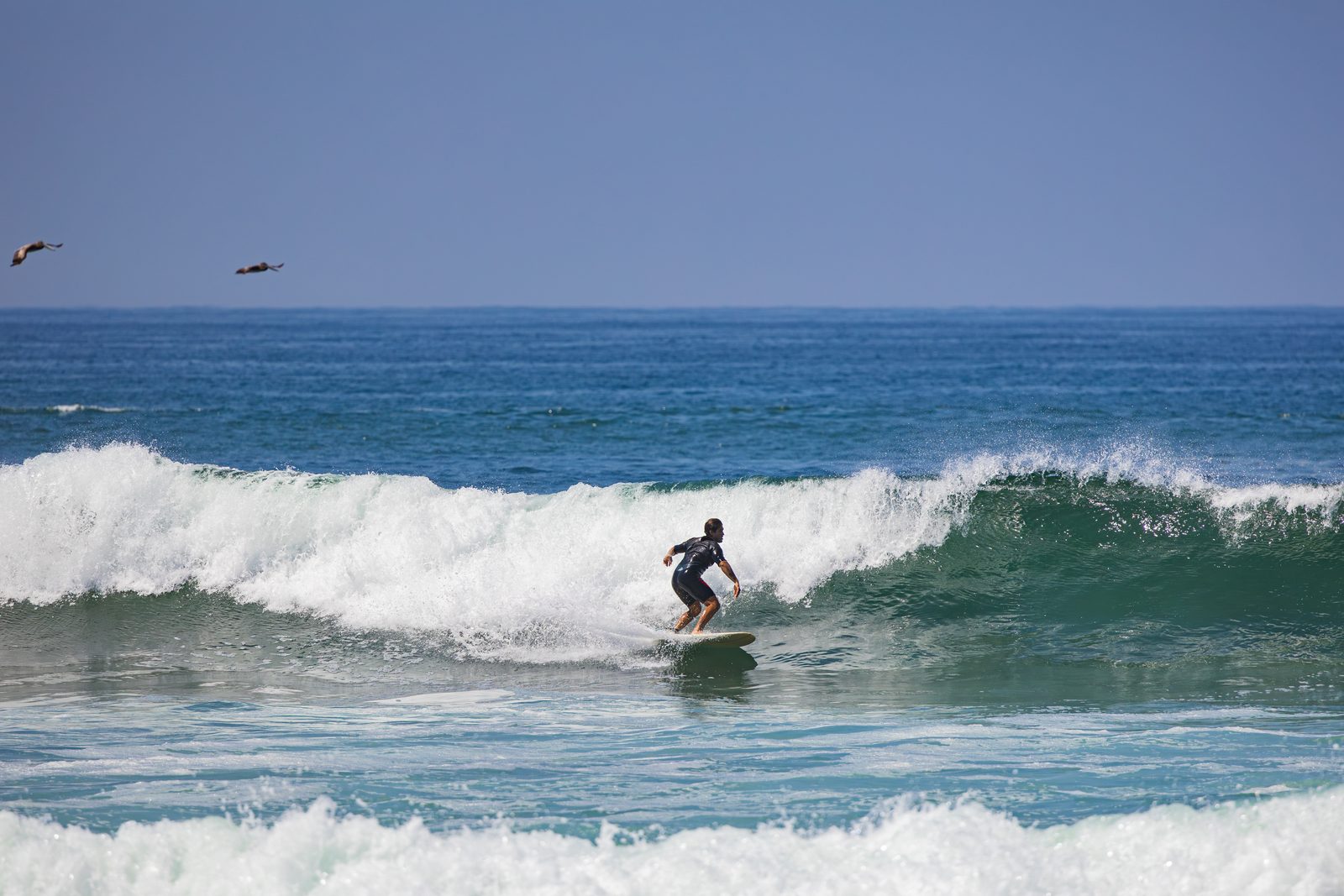
First, the honest part: the waves are not in the city
Puerto Vallarta itself is a bay inside a bay, and that geography is exactly why the water is calm — great for snorkeling and boat days, bad for surf. The one urban exception is Playa de los Muertos / Olas Altas, where the sandbars from the Cuale River can produce a wave, but only during hurricane swells. The rest of the year it simply does not break.
The real surf sits at the north end of the bay: Punta de Mita, about 45 minutes by car, and Sayulita, a little beyond. That is where every honest surf school in the area takes you. If somebody offers you a beginner surf lesson on the Malecón, you are being sold a car ride they did not mention.
Plan for the drive. A lesson is roughly 1.5 to 2 hours in the water, so with transport it eats half a day — and that half day is best spent in the morning, for the reason in the next section.
Surf early: the bay changes at midday
The daily pattern here is unusually reliable. Mornings wake up glassy, with a light offshore breeze that grooms the wave face. By late morning the sea breeze turns onshore, the surface gets choppy, and the same spot that looked perfect at 7 a.m. looks messy at noon.
The local rule is to be in the water before 10 or 11 a.m. It is not a preference, it is the difference between a clean wave and a bumpy one, and it is why surf schools here start early rather than fitting you in after lunch.
The two seasons, and which one suits you
November to April is the north swell season. Winter storms in the North Pacific send swell that wraps into the bay and arrives organized: chest-high, glassy and long in Punta de Mita. This is the classic season to learn and the best one for longboarding. It is also the dry season, and the same months when humpback whales are in the bay.
May to October is the south swell season. Storms in the southern hemisphere wrap swell around the Punta de Mita peninsula and wake up its points and reefs — La Lancha, Punta Burros and, on bigger days, the outer reefs. Waves typically run 3 to 5 feet and the water is at its warmest. It has more push, which is what you want once you are past your first waves.
Either way, you do not need a wetsuit. The water is warm year-round; board shorts and a rash guard are the whole kit.
Where to surf, by level
El Anclote, in Punta de Mita, is the classic first-wave spot: soft, long right-handers rolling in front of the village, with an easy paddle and room for everyone. It is where most first lessons happen.
La Lancha is the most versatile wave around. It is a reef point with several peaks that spread the crowd out — the inside section works as a beginner classroom while the outside peak has enough power for advanced boards. You reach it by a short jungle trail off the Punta de Mita highway.
Sayulita is the surf-town postcard: mellow rights and lefts breaking right in front of town, with restaurants and hammocks waiting when you come out. Good for beginners and intermediates, and busier than the rest.
Punta Burros is the natural step up when El Anclote starts feeling small — a rock-bottom point serving mostly rights, best on south swell.
And then there are the waves you cannot walk to. Quimixto is a long left over rock and reef, breaking in front of a village with no roads on the south side of the bay, and it only works with the winter north swells. La Bahia and El Faro, off the tip of Punta de Mita, are advanced reefs that are far easier to reach by boat than by scrambling over rocks. These are the spots that stay empty, for the obvious reason.
What a lesson costs around here
Private lessons in the area run roughly $80 to $115 USD per person, and every school includes the board, the leash and a rash guard — gear is never a separate charge, so treat any 'equipment fee' as a red flag. Group lessons come down to about $70 to $95 per person, and board rentals run around $32 to $40 USD per day.
The wide gap is at the top end: resort operators charge $270 USD and up for the same 90 minutes, and boat-based surf trips range from about $120 USD for a local run to $725 USD for a full safari. Knowing that range is the point — it tells you when a price is fair and when you are paying for a lobby.
Our own lessons are $90 USD for one person and $150 USD for two, both 1.5 hours with gear included, and board rentals start at $35 USD a day. Prices are per session, and we quote groups of three or more individually.
What actually happens in your first lesson
It starts on the sand, not in the water: where to lie on the board, how to pop up, and — the part that matters most — how to fall safely and where not to be when a wave breaks. Fifteen minutes, and it saves you an hour of flailing.
Then you go in on a soft-top board, which is wide, floaty and forgiving, with your instructor beside you in waist-deep water pushing you into the whitewater. Most people stand up in their first session. Some do it on the third wave, some on the fifteenth, and both are completely normal.
Bring swimwear, reef-safe sunscreen, a towel and water. Leave the sunglasses and anything you would hate to lose on shore. If you burn easily, wear the rash guard even when it feels warm — you are facing straight into reflected sun for two hours.